DEPARTMENT PROFILE • 2026
Building Quantum Computers Atom by Atom
Introducing the Department of Frontier Interdisciplinary Photonics at the Shanghai Institute of Optics and Fine Mechanics
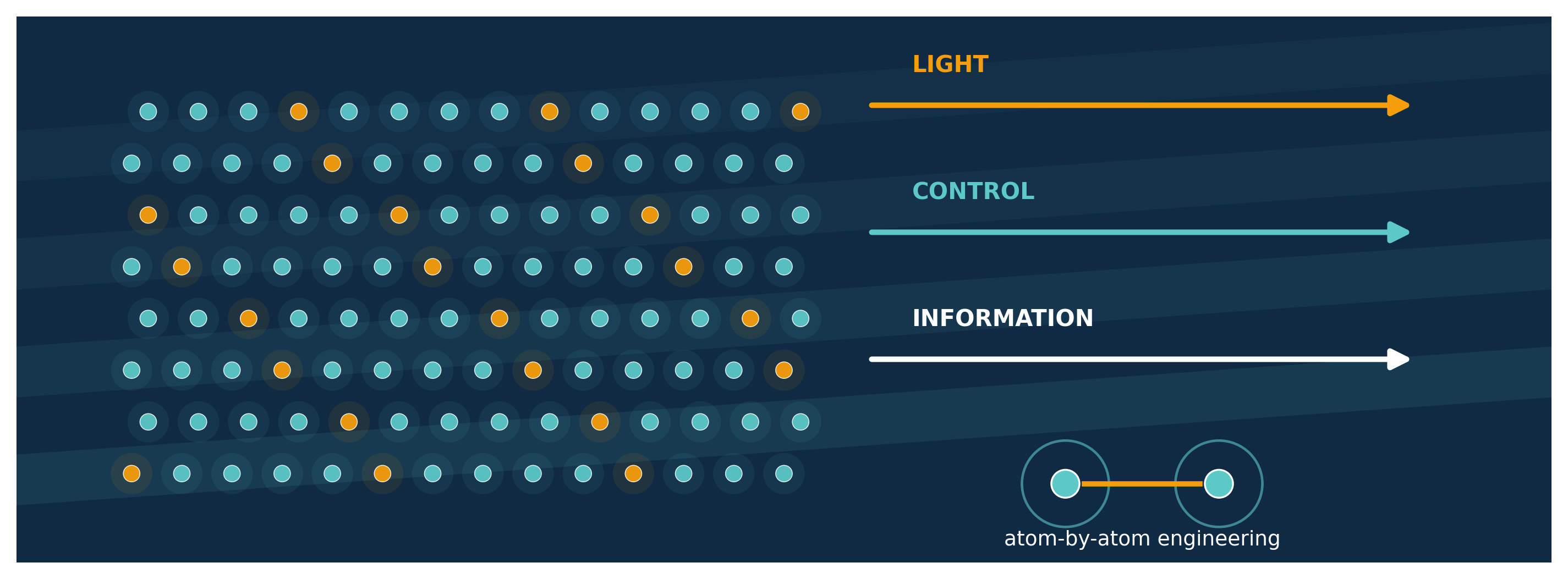
A new interdisciplinary department is assembling the science and engineering stack required for scalable neutral-atom quantum computing—from optical tweezers and high-fidelity gates to integrated photonics, control electronics, error correction, and quantum artificial intelligence.
The next generation of computing will not be defined by a faster clock alone. It will be defined by new ways of representing and manipulating information. Quantum computers exploit the laws of quantum mechanics—superposition, interference, and entanglement—to process information in ways that have no direct classical analogue. Their promise is specific rather than universal: for carefully structured problems, a quantum processor may simulate nature more directly, reveal patterns that are exceptionally costly to extract classically, or execute algorithms whose resource requirements grow much more slowly than those of known classical methods.
Turning that scientific promise into a reliable machine is one of the most demanding systems-engineering challenges of our time. A useful quantum computer needs excellent qubits, but it also needs lasers, optics, vacuum technology, electronics, real-time feedback, control software, compilers, error correction, fabrication, packaging, and algorithms that have been designed to work together. Improving one subsystem while neglecting another simply moves the bottleneck.
The Department of Frontier Interdisciplinary Photonics (光电前沿交叉部) at the Shanghai Institute of Optics and Fine Mechanics (SIOM), Chinese Academy of Sciences, was established in 2025 around this full-stack perspective. Its central mission is the development of a complete neutral-atom quantum computer. By advancing qubit-control precision, large-scale array integration, high-fidelity quantum gates, continuous loading, and integrated system engineering, the Department aims to construct a proof-of-concept machine and ultimately perform rigorous tests of quantum computational advantage. At the same time, it provides graduate students, postdoctoral researchers, engineers, and visiting scholars with a platform for original research at the intersection of frontier science and high-impact technology.
A classical bit stores either 0 or 1. A qubit can be prepared in a coherent combination of the two, commonly written as |ψ⟩ = α|0⟩ + β|1⟩, where the complex amplitudes α and β determine measurement probabilities. For n qubits, the mathematical state generally contains 2ⁿ amplitudes. The exponential growth illustrated in Figure 1 is why quantum systems become difficult to reproduce exactly on classical hardware.
That statement needs an important qualification. Measuring a quantum register does not reveal all 2ⁿ amplitudes, and a quantum computer does not simply “try every answer at once.” A successful quantum algorithm engineers interference so that unwanted computational paths cancel while useful paths reinforce one another. Entanglement distributes correlations across qubits, and measurement converts the resulting quantum state into classical data. The advantage, when it exists, comes from the entire algorithmic structure—not from superposition alone.
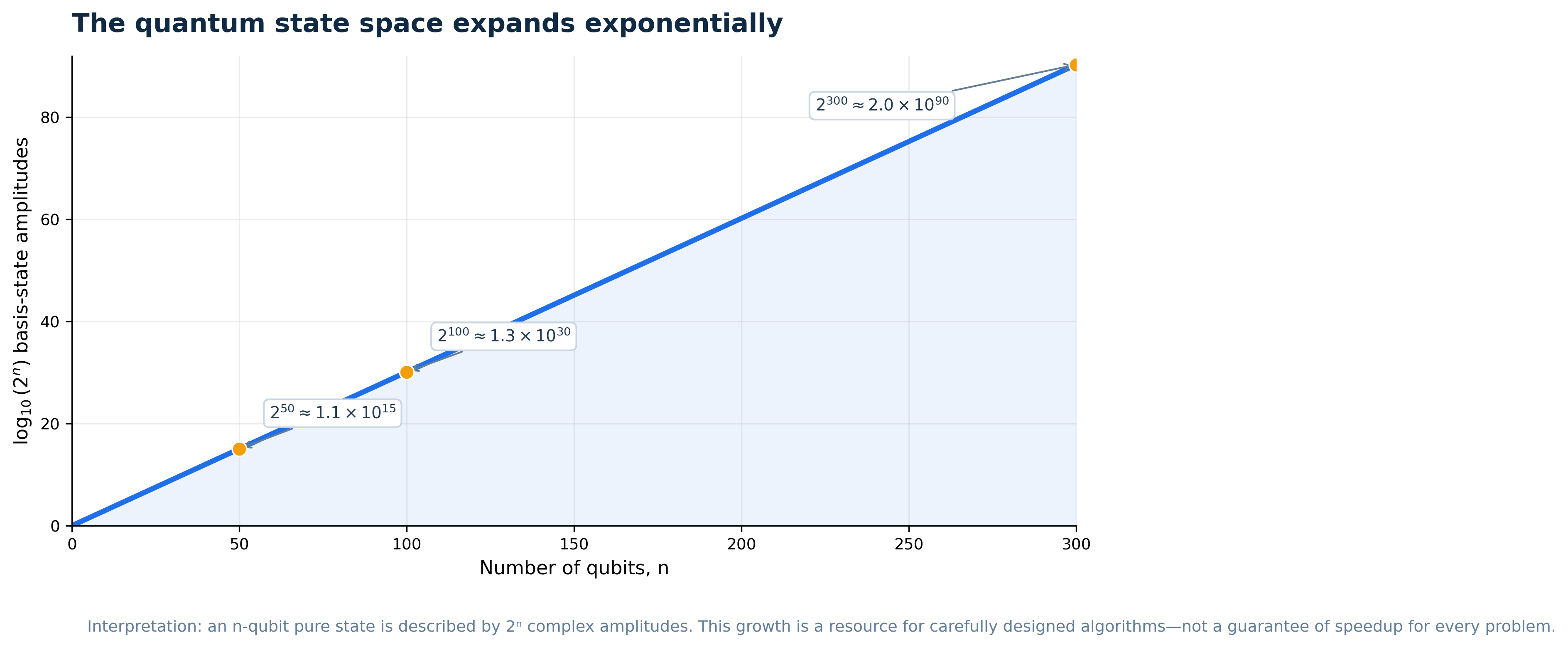
Figure 1 | The rapidly expanding quantum state space. An n-qubit pure state generally requires 2ⁿ complex amplitudes for an exact classical description. This exponential representation is a computational resource only when an algorithm can shape interference and extract a useful answer efficiently. Original graphic.
The deepest motivation is that the world itself is quantum mechanical. Molecules, catalysts, magnetic materials, and many-body phases are governed by quantum rules. Simulating their full behavior on a classical computer can require tracking a state space that expands exponentially with system size. Richard Feynman’s early argument for quantum simulation was therefore direct: use a controllable quantum system to model another quantum system [1]. Today, this idea underlies research in quantum chemistry, materials discovery, condensed-matter physics, high-energy physics, and precision metrology.
A second motivation comes from algorithms. Shor’s factoring algorithm established that a sufficiently large, error-corrected quantum computer could solve an important number-theoretic problem in polynomial time, with major implications for public-key cryptography [2]. Other quantum algorithms offer speedups for structured search, linear algebra, sampling, and selected optimization or machine-learning subroutines. Yet responsible research distinguishes proven complexity advantages from application claims that still depend on data loading, error correction, and end-to-end resource costs. Quantum computing is best viewed as a specialized accelerator for certain problem classes, not a replacement for classical computing.
A third motivation is scientific instrumentation. A programmable quantum processor is not only a computer; it is also an exquisitely controlled many-body laboratory. The same hardware can probe non-equilibrium dynamics, generate entangled states for sensing, test quantum error-correction protocols, and study the boundary between quantum and classical behavior. For a research department, this dual identity—machine and experiment—creates unusually rich opportunities for fundamental discovery.
Every hardware platform makes a different trade-off among coherence, gate speed, connectivity, fabrication, and scalability. Neutral-atom quantum computing uses individual atoms held in tightly focused laser beams called optical tweezers. Internal atomic states encode the qubit. Laser or microwave fields perform single-qubit rotations, while temporary excitation to highly interacting Rydberg states enables entangling gates. Fluorescence imaging reveals the final state of each atom [3,4].
Neutral atoms offer a compelling combination of natural uniformity and programmable geometry. Unlike manufactured solid-state devices, atoms of the same isotope are intrinsically identical. Large numbers of optical traps can be generated with spatial light modulators, acousto-optic deflectors, diffractive optics, or metasurfaces. Because the atoms can be moved between zones, the interaction graph is not permanently fixed: qubits can be compacted into defect-free arrays, routed to gate regions, stored away from intense light, and transported to readout regions. This reconfigurability is especially attractive for quantum simulation and error-correction codes whose connectivity requirements change during a circuit.
The platform also supports long-lived qubits. Hyperfine or clock-state encodings can remain coherent for times far longer than a typical gate, creating headroom for calibration, transport, and repeated error-correction cycles. Neutral-atom apparatus can operate without a dilution refrigerator: the surrounding vacuum chamber and optics may be near room temperature, while the atoms themselves are laser-cooled to microkelvin temperatures. This can simplify some infrastructure, although it does not make the experiment easy. High optical power, submicrometre alignment, ultra-high vacuum, laser-frequency stability, and fast real-time control are all essential.
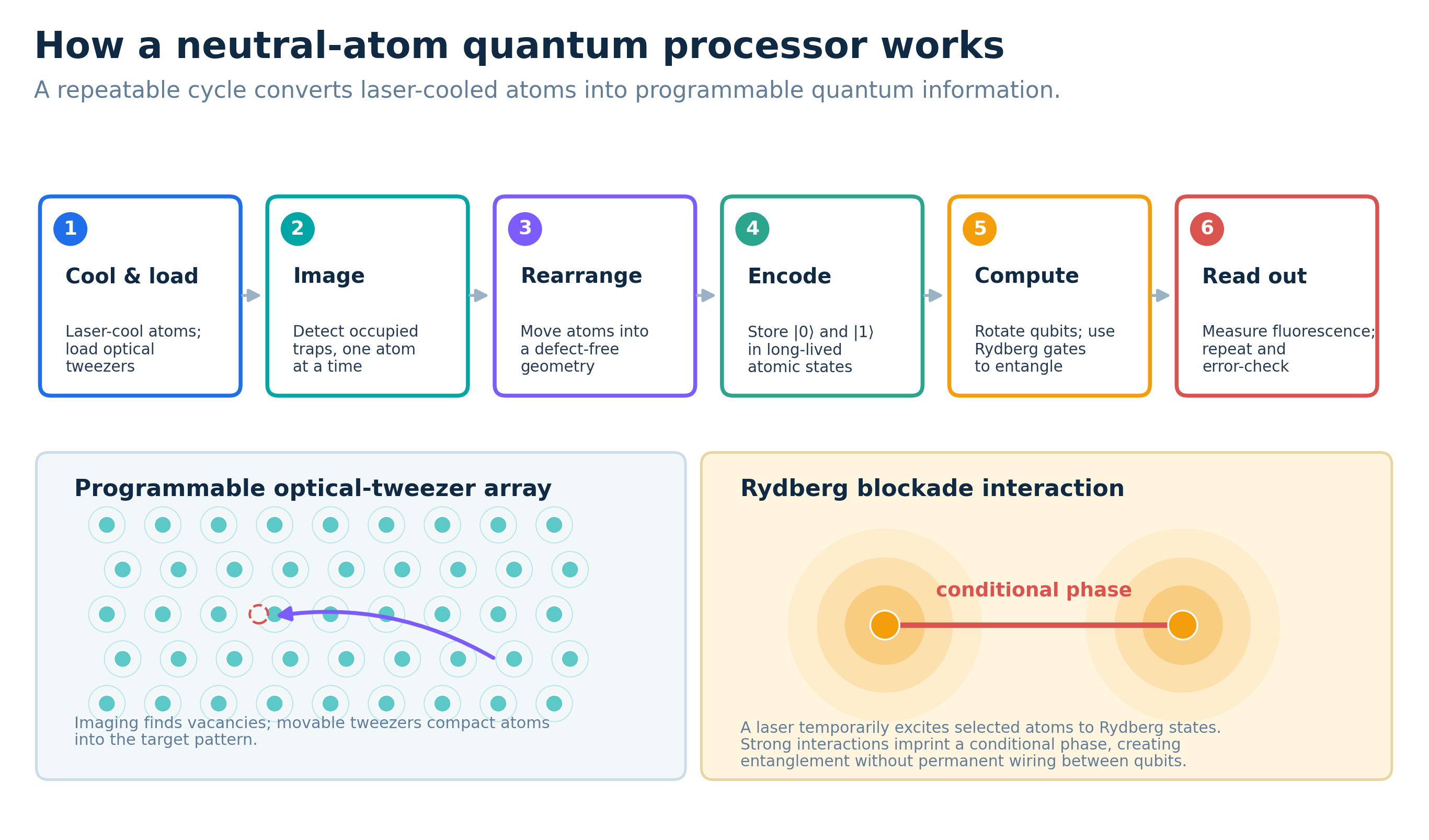
Figure 2 | The neutral-atom processor cycle. Atoms are cooled and loaded, imaged, rearranged, encoded, coherently controlled, entangled through Rydberg interactions, and measured. The workflow must be automated and repeated at high fidelity. Original schematic.
Large arrays are useful only if the atoms can be initialized, preserved, controlled, entangled, and measured with sufficiently low error. Conversely, spectacular gate fidelity on a handful of qubits does not by itself produce a useful computer. The neutral-atom roadmap therefore has several coupled objectives: more qubits, lower gate error, longer coherence, faster and less destructive imaging, reliable atom transport, continuous replacement of lost atoms, and control systems that remain stable as the number of channels grows.
This coupling explains why neutral-atom quantum computing is fundamentally interdisciplinary. A change in optical design alters trap uniformity; trap uniformity affects atom temperature and gate errors; gate errors determine the overhead of quantum error correction; error-correction schedules change the required transport and readout architecture; and those schedules determine the bandwidth of electronics and software. The Department is organized to work across these interfaces rather than treating them as separate projects.
The Department’s core task is not to optimize one isolated component. It is to develop a neutral-atom quantum computer as an integrated instrument: atomic qubits, optical architecture, control electronics, software, calibration, algorithms, and engineering infrastructure assembled into a repeatable system. The target is a proof-of-concept complete machine capable of testing scientifically meaningful workloads and, as the hardware matures, of evaluating quantum advantage under transparent and reproducible benchmarks.
This objective shapes the research culture. Experiments are judged not only by a local metric—such as a narrower laser linewidth or a faster waveform—but also by their effect on system performance. Can the improvement be scaled to thousands of sites? Does it reduce calibration time? Does it preserve coherence during atom motion? Does it simplify error correction? Can it be manufactured, packaged, and maintained? These questions turn basic research into a coherent technology program without sacrificing scientific depth.
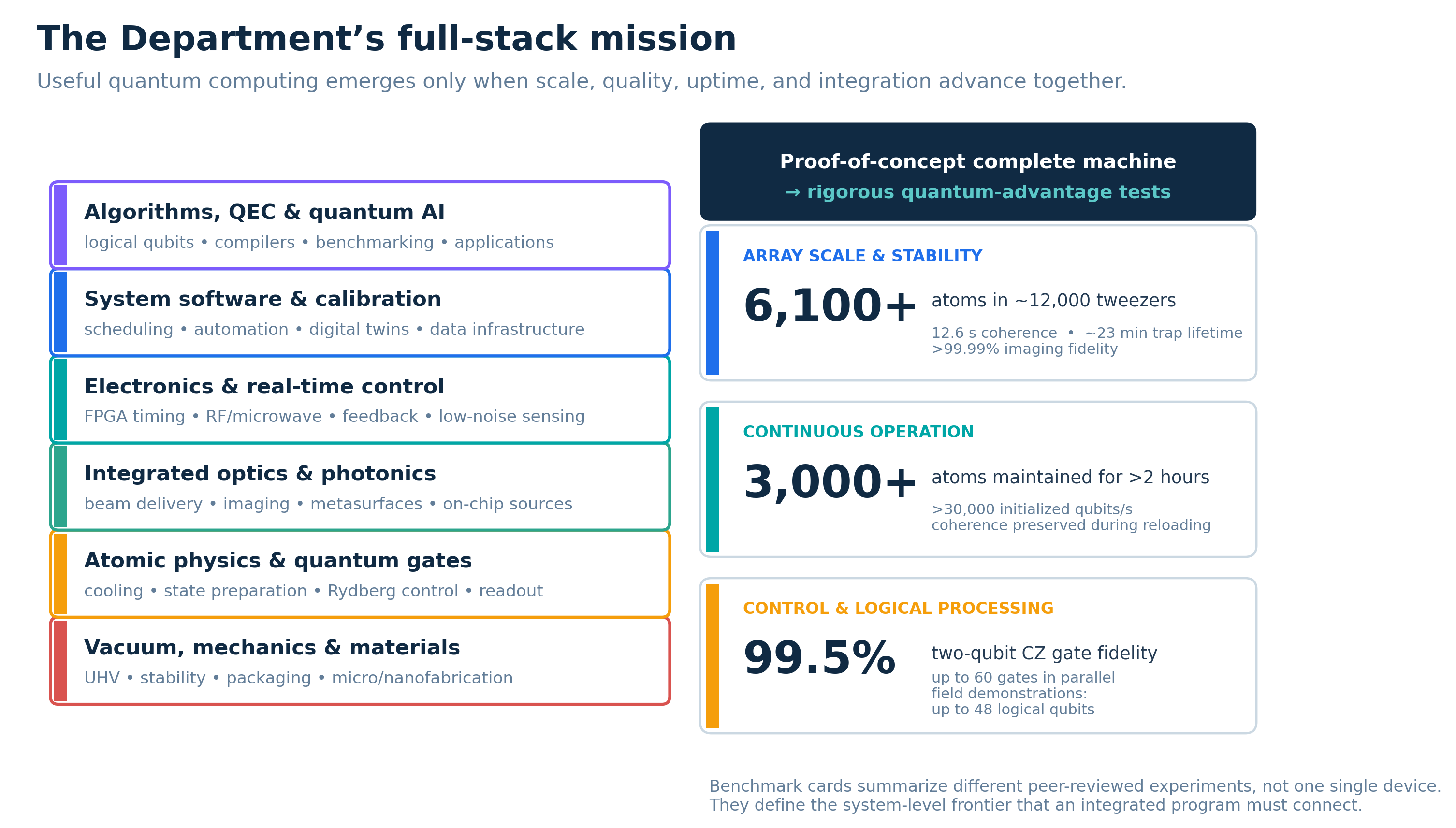
Figure 3 | A full-stack neutral-atom quantum-computing program. The benchmark cards summarize distinct peer-reviewed experiments—large-array stability [8], continuous operation [9], high-fidelity gates [6], and logical processing [7]—rather than one device. Original synthesis.
Scale begins with the ability to create many uniform optical tweezers, load atoms efficiently, identify vacancies, and rearrange the atoms into a desired geometry. The Department studies large-array optics, hologram generation, aberration correction, parallel transport, high-dynamic-range imaging, and algorithms that minimize movement time and loss. It also investigates continuous loading: instead of stopping an experiment whenever atoms are lost, fresh atoms can be prepared in a reservoir and delivered to the computation region while stored qubits retain their quantum state.
A landmark piece of prior experience connected to the Department is the 6,100-atom optical-tweezer array reported in Nature in 2025. The work, co-authored by Xudong Lv, who is now at SIOM, trapped more than 6,100 cesium atoms in 11,998 sites. It demonstrated a 12.6-second hyperfine-qubit coherence time, a room-temperature-apparatus trap lifetime of about 23 minutes, imaging survival of 99.98952%, imaging fidelity above 99.99%, and coherence-preserving transport [8]. These numbers matter because quantum error correction requires thousands of repeated operations without silently losing or misidentifying qubits.
|
What the 6,100-atom result means—and what it does not It is a large-scale array and control benchmark: thousands of individually trapped qubits were maintained with exceptional coherence, lifetime, imaging, and transport performance. It should not be described as a fully universal 6,100-qubit processor executing high-fidelity entangling gates across the entire array. The scientific value lies in establishing several prerequisites that a future large processor will need simultaneously. |
Continuous operation is the next step beyond one-time assembly. In a separate 2025 field benchmark, researchers initialized more than 30,000 qubits per second and maintained an array of more than 3,000 atoms for over two hours while preserving coherent storage during reloading [9]. This result illustrates why continuous loading is a strategic research direction: a fault-tolerant machine must replace lost physical qubits without resetting the logical computation.
Quantum computation requires universal control: reliable single-qubit rotations plus an entangling operation. In neutral atoms, the leading entangling mechanism uses Rydberg blockade. When one atom is excited to a high principal quantum number, its strong interaction shifts the resonance of nearby atoms, making the evolution of one qubit conditional on the state of another. With precise pulse shaping, this interaction implements controlled-phase gates and multi-qubit operations.
The Department works on laser phase and intensity control, atomic cooling, electric-field compensation, pulse optimization, Rydberg-state spectroscopy, crosstalk suppression, and calibration protocols. These efforts target both fidelity and parallelism. A widely cited 2023 experiment demonstrated 99.5% two-qubit CZ gates on as many as 60 atoms in parallel, together with single-qubit rotations above 99.97% [6]. Such results show that neutral atoms can reach error rates relevant to quantum error correction, but scaling those fidelities to larger arrays and longer circuits remains a central challenge.
Gate fidelity is not a single number detached from context. It depends on atom temperature, laser noise, spatial inhomogeneity, state leakage, loss, and the benchmarking protocol. Department projects therefore combine microscopic error models with hardware diagnostics and statistically rigorous characterization. The aim is not only to report a high fidelity but to understand the error budget well enough to predict and improve complete-circuit performance.
Atom loss is a distinctive neutral-atom error channel. It can arise from background-gas collisions, imaging, imperfect transport, or Rydberg operations. Because a missing atom can often be detected, loss can sometimes be converted into a known erasure error, which quantum codes can handle more efficiently than an unknown Pauli error. But the physical site still has to be refilled. Continuous loading research addresses the entire sequence: reservoir preparation, transport into the science chamber, cooling, imaging, sorting, qubit initialization, delivery to the processor, and protection of qubits already in use.
This direction connects atomic physics to mechanical layout, optical shielding, timing electronics, and error-correction scheduling. A successful solution must reload faster than atoms are lost, prevent scattered cooling light from decohering stored qubits, and expose a clean software interface so that the control stack knows which physical resources are available. It is a clear example of why whole-machine co-design is essential.
A laboratory demonstration can rely on expert intervention; a computer must be repeatable. The Department therefore studies integrated neutral-atom quantum-computer architecture: stabilized laser systems, compact beam delivery, high-numerical-aperture imaging, vacuum and thermal design, automated alignment, calibration databases, health monitoring, deterministic experiment sequencing, and modular subsystem interfaces. The objective is to reduce the amount of tacit knowledge required to operate the machine and to make performance reproducible across days, operators, and hardware revisions.
Photonics is central to that transition. Metasurfaces can replace bulky beam-shaping optics with planar devices containing millions of subwavelength elements. A 2026 Nature experiment used holographic metasurfaces to trap more than 100 individual strontium atoms in arbitrary geometries and demonstrated a 360,000-trap optical pattern [10]. Nanophotonic chips offer another route to compact interfaces: atom arrays have been operated near chips containing more than 100 optical cavities with background-free imaging [11]. These are field-level examples of the technologies the Department seeks to develop through its research on metasurfaces, on-chip light sources, photonic-chip materials, and quantum applications.
“Quantum AI” has two complementary meanings in the Department. The first is AI for quantum hardware. Machine learning can infer aberration corrections, generate holograms, optimize pulse sequences, detect drift, prioritize calibrations, and build surrogate models of a complex apparatus. In 2025, an AI-enabled protocol assembled defect-free two- and three-dimensional arrays of up to 2,024 atoms in a constant 60 milliseconds by calculating holograms for parallel rearrangement [12]. This illustrates how algorithms can remove a control bottleneck that would otherwise grow with array size.
The second meaning is quantum computing for AI and data-intensive science. Researchers can study quantum kernels, variational circuits, generative models, and hybrid quantum-classical workflows while carefully accounting for noise and sampling cost. Near-term projects may focus less on broad claims of “quantum machine learning advantage” and more on testable questions: Which data structures map naturally to neutral-atom connectivity? Which models remain trainable under realistic noise? Can analog Rydberg dynamics serve as a useful feature map? What verification methods distinguish genuine quantum contributions from classical baselines?
A useful quantum computer will encode each logical qubit across many physical qubits so that errors can be detected and corrected. Neutral-atom reconfigurability is especially valuable here: atoms can be moved between storage, entangling, and readout zones, and logical blocks can receive operations in parallel. A 2024 demonstration operated with up to 280 physical qubits, ran 40 color-code qubits, and executed circuits with up to 48 logical qubits using error detection [7]. The result did not eliminate the need for further error reduction, but it established that logical-level control can be a native design principle rather than an afterthought.
For the Department, quantum error correction is therefore a hardware-software co-design problem. Code choice affects geometry; geometry affects transport; transport affects coherence; measurement cadence affects imaging and electronics; and decoder latency affects the real-time control system. Projects in this area link quantum information theory directly to laboratory architecture.
A neutral-atom quantum computer is a meeting point for many disciplines. Students and scholars do not need to arrive as experts in every layer. They need depth in one area, curiosity about adjacent layers, and a willingness to validate their work against system-level requirements. The Department welcomes backgrounds in physics, quantum information, computer science, electronic information, optics, materials, and engineering [13]. Figure 4 shows how these backgrounds connect.
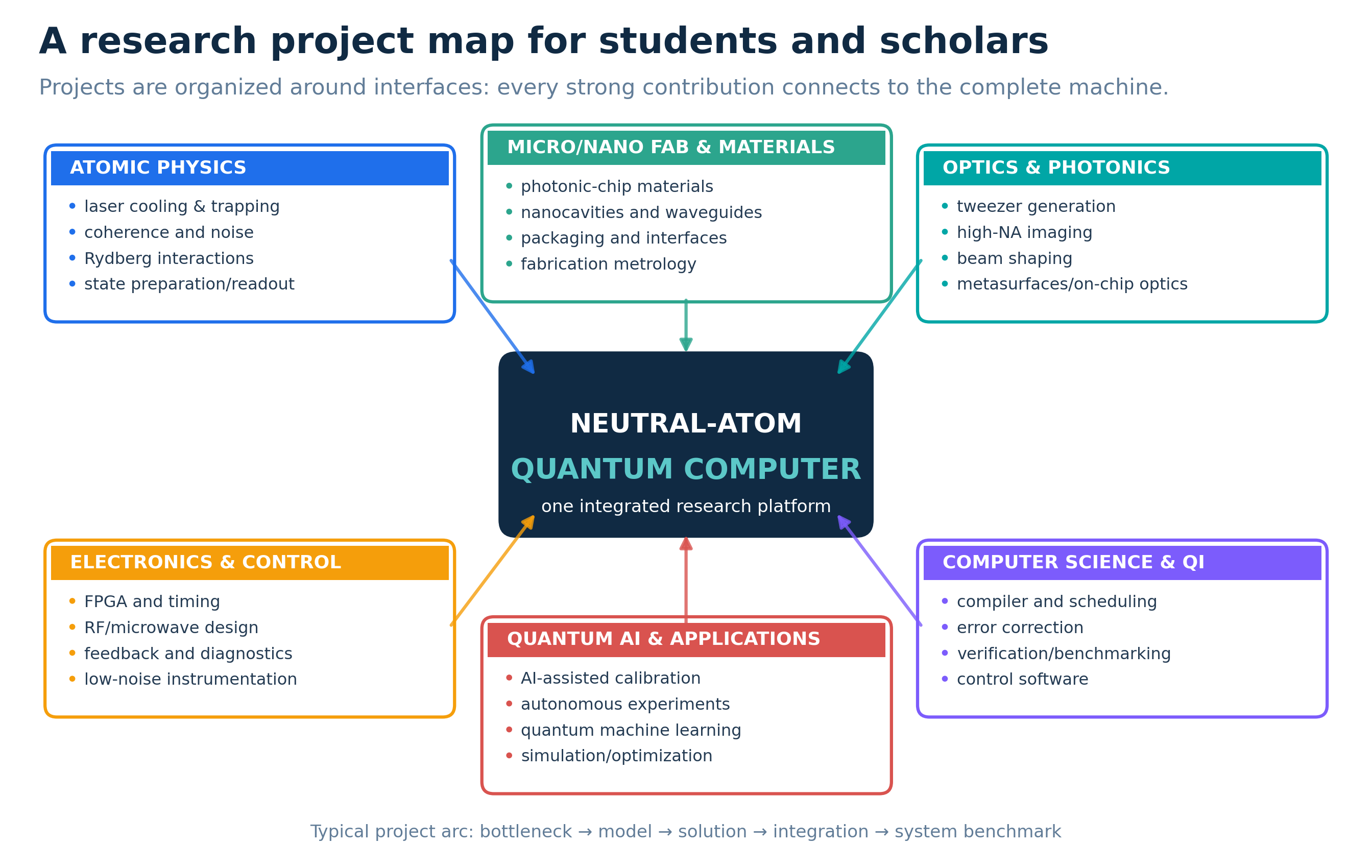
Figure 4 | Research opportunities converge on the complete machine. Each project begins in a discipline but is evaluated at an interface—where optical, atomic, electronic, computational, or materials performance changes system behavior. Original schematic.
Projects in atomic physics address the qubit at its most fundamental level. A student might design laser-cooling sequences that reduce motional dephasing, characterize magnetic and electric field sensitivity, optimize optical pumping, or identify the dominant mechanisms behind state loss and leakage. Another project might compare hyperfine, clock-state, and nuclear-spin encodings for a particular atomic species, balancing coherence against laser complexity and gate speed.
Rydberg physics offers a second cluster of projects: spectroscopy of high-lying states, electric-field compensation, blockade uniformity, optimal-control pulse design, multi-qubit gates, and error conversion. These projects combine theoretical modeling with demanding experiments. Students learn to move between Hamiltonians, simulations, laser diagnostics, and statistical benchmarks—an unusually complete training in modern quantum science.
|
PROJECT |
Example project: Coherence under motion Develop a transport protocol that moves qubits between storage and gate zones while preserving phase. Build a noise model, design trajectory and trap-depth waveforms, measure Ramsey contrast after repeated moves, and quantify the improvement in an error-correction schedule rather than reporting transport fidelity alone. |
Neutral-atom hardware is an optical computer in the literal sense: light traps the qubits, initializes them, rotates them, entangles them, and reads them. Optics projects may involve high-numerical-aperture objective design, aberration correction, large-field imaging, spatial light modulators, acousto-optic deflectors, fiber delivery, laser locking, frequency conversion, and beam-shaping algorithms. Researchers can work on the precision optics needed today or on integrated photonic architectures that could make tomorrow’s systems smaller and more stable.
Metasurfaces are a particularly fertile interface between photonics and quantum technology. Their subwavelength structures can shape phase, amplitude, and polarization in a compact device. Department projects can explore metasurface-generated tweezer arrays, multifunctional atom-imaging optics, wavefront correction, polarization control, or interfaces between atoms and nanophotonic resonators. The key question is always system-level: can the device deliver the efficiency, uniformity, stability, and optical access required for quantum control?
|
PROJECT |
Example project: Planar optics for thousand-site arrays Design and fabricate a metasurface that creates a uniform, large-area tweezer pattern at an atomic transition wavelength. Combine electromagnetic simulation, fabrication-tolerance analysis, cleanroom processing, optical characterization, and an atom-loading test. The final benchmark should include trap-depth uniformity and atom survival, not optical efficiency alone. |
A large neutral-atom system is driven by an orchestra of synchronized signals: radio-frequency waveforms for deflectors, microwave pulses, laser shutters, modulators, cameras, magnetic-field coils, photodetectors, temperature sensors, and safety interlocks. Electronics projects can focus on low-noise analog design, RF generation, clock distribution, FPGA sequencing, camera interfaces, real-time image processing, or high-bandwidth feedback. The engineering objective is deterministic timing with low latency and traceable performance.
As the system grows, calibration itself becomes a control problem. A promising project might build an autonomous calibration service that detects drift, chooses the most informative measurement, updates model parameters, and deploys corrections without interrupting experiments unnecessarily. Such work draws on estimation theory, embedded systems, databases, and machine learning, and it can have an immediate impact on experimental uptime.
|
PROJECT |
Example project: A real-time atom-array controller Implement an FPGA/GPU pipeline that receives a fluorescence image, identifies occupied sites, computes a rearrangement plan, and streams synchronized waveforms to the transport hardware. Characterize end-to-end latency, detection errors, and failure recovery under realistic data rates. |
Computer scientists can contribute at every layer above the physical apparatus. Control software must represent hardware resources, compile circuits into atom movements and laser pulses, schedule parallel gates, track calibrations, log provenance, and recover safely from faults. Because neutral atoms can move, compilation is not merely gate decomposition; it is also a dynamic routing and geometry problem. Algorithms that reduce transport distance or expose parallel Rydberg gates can directly improve fidelity and runtime.
Quantum-information projects include error-correcting codes adapted to atom loss, decoder design, randomized benchmarking, cross-entropy and application-level validation, logical-state preparation, mid-circuit measurement, and resource estimation. Theory students can work closely with experimentalists by translating a code into concrete requirements: number of sites, measurement cadence, connectivity, feedback latency, and permissible error correlations.
|
PROJECT |
Example project: Compiler-aware error correction Co-design a logical-qubit layout and routing compiler for a zoned neutral-atom architecture. Compare code families under measured gate, loss, transport, and readout errors, then identify the architecture that minimizes logical error per unit time—not merely the number of physical qubits. |
Scaling quantum hardware ultimately requires manufacturing. Researchers in micro- and nanofabrication can develop metasurfaces, waveguides, nanocavities, grating couplers, electrodes, atom chips, micro-optics, and alignment features. Materials projects may investigate low-loss dielectrics, laser-damage resistance, thermal stability, surface charging near Rydberg atoms, heterogeneous integration, or thin-film sources and amplifiers. Metrology is equally important: a device that cannot be characterized reliably cannot be integrated into a quantum system.
Packaging projects bridge the cleanroom and the optical table. They may involve fiber attach, vacuum-compatible bonding, thermal expansion, contamination control, stray-light suppression, or replaceable modules with precision mechanical datums. These questions are often underestimated in early experiments, yet they determine whether a component remains aligned and stable after months of operation.
|
PROJECT |
Example project: Atom-compatible nanophotonic interface Fabricate a low-loss photonic structure with integrated alignment and charging mitigation. Test optical performance first, then measure its effect on nearby atom trapping, imaging background, coherence, and Rydberg spectroscopy. The project succeeds only when the photonic and atomic metrics are both acceptable. |
Students interested in AI can build tools for experimental automation, anomaly detection, Bayesian optimization, reinforcement learning, or learned physical models. A high-value project may reduce the number of experiments required to calibrate a thousand-site array, predict a developing hardware fault from telemetry, or generate control waveforms that are robust to measured uncertainty. These are concrete, measurable uses of AI that improve the scientific instrument.
Application-oriented researchers can study quantum simulation of spin models and many-body dynamics, optimization problems native to Rydberg blockade graphs, hybrid algorithms, and quantum machine learning. Strong projects begin with a fair classical baseline and an explicit resource model. They ask not only “Can this run on the quantum device?” but “What quantum resource is being used, how will we verify the result, and under what scaling assumptions could an advantage emerge?”
|
PROJECT |
Example project: Verified Rydberg learning model Use analog Rydberg dynamics as a trainable feature map for a structured dataset. Establish classical baselines, analyze noise and shot complexity, design verification tests, and determine whether the physical model offers a measurable benefit under realistic hardware constraints. |
The Department’s most important educational asset is the complete system. A student can begin with a focused problem—a laser lock, a gate pulse, a compiler pass, a metasurface, or a decoder—and then follow its consequences through the stack. This encourages three habits. First, quantify performance with reproducible benchmarks. Second, expose assumptions and interfaces so that others can integrate the result. Third, compare each improvement against the actual bottleneck of the machine.
Projects can be experimental, theoretical, computational, or engineering-led, but they are rarely isolated. An optics student may work with an atomic physicist to test trap uniformity; a computer scientist may work with an FPGA engineer to close a feedback loop; a materials researcher may work with a quantum-information theorist to understand how surface-induced noise changes logical overhead. This collaboration is not an extracurricular feature—it is the method required to build the machine.
For graduate students, the result is training that spans first-principles science and complex-system execution. For postdoctoral researchers and visiting scholars, it is an opportunity to lead an interface where a field can be moved forward. For engineers, it is a chance to turn fragile laboratory capabilities into robust subsystems. All contribute to the same objective: a scalable, high-fidelity, continuously operated, integrated neutral-atom quantum computer.
Quantum computing will be built through the convergence of disciplines. Neutral atoms provide an unusually powerful foundation: qubits supplied by nature, arrays shaped by light, interactions switched on demand, and geometries reconfigured by software. But their promise becomes real only when atomic physics, photonics, electronics, fabrication, computer science, and quantum information are engineered as one system.
The Department of Frontier Interdisciplinary Photonics was created for that convergence. Its research program spans large neutral-atom arrays, high-fidelity gates, continuous loading, complete-machine integration, quantum AI, metasurfaces, on-chip light sources, and photonic-chip materials and technologies. The ambition is both scientific and practical: discover new physics, invent enabling technologies, build a working machine, and test where quantum computation can provide genuine value.
For students and scholars, this is an invitation to choose a hard problem with a clear interface to the whole. The next breakthrough may begin as a better optical coating, a faster image decoder, a quieter microwave source, a more robust gate, a new error-correcting code, or a nanoscale photonic component. In a full-stack program, each can become part of something larger: a quantum computer built atom by atom, layer by layer, and benchmark by benchmark.
|
Neutral-atom quantum computing |
Large-scale neutral-atom arrays |
High-fidelity neutral-atom gate operations |
|
Continuous loading and atom replacement |
Integrated neutral-atom quantum-computer systems |
Quantum artificial intelligence |
|
Metasurfaces and their quantum applications |
On-chip light sources and their quantum applications |
Key materials and technologies for photonic chips |
|
Editorial accuracy note Array size, gate fidelity, coherence time, continuous-operation duration, and logical-qubit count describe different experimental capabilities. They should not be combined into a claim that one existing machine simultaneously achieves all of these metrics. The article distinguishes departmental objectives, prior experience connected to the Department, and broader field benchmarks. | ||
The scientific benchmarks in this profile are drawn from peer-reviewed primary literature and official SIOM materials. All figures are original graphics prepared for this article.
1. R. P. Feynman, “Simulating physics with computers,” International Journal of Theoretical Physics 21, 467–488 (1982).
2. P. W. Shor, “Algorithms for quantum computation: discrete logarithms and factoring,” Proceedings of the 35th Annual Symposium on Foundations of Computer Science, 124–134 (1994).
3. M. Saffman, T. G. Walker, and K. Mølmer, “Quantum information with Rydberg atoms,” Reviews of Modern Physics 82, 2313–2363 (2010).
4. L. Henriet et al., “Quantum computing with neutral atoms,” Quantum 4, 327 (2020).
5. J. Preskill, “Quantum computing in the NISQ era and beyond,” Quantum 2, 79 (2018).
6. S. J. Evered et al., “High-fidelity parallel entangling gates on a neutral-atom quantum computer,” Nature 622, 268–272 (2023).
7. D. Bluvstein et al., “Logical quantum processor based on reconfigurable atom arrays,” Nature 626, 58–65 (2024).
8. H. J. Manetsch et al., “A tweezer array with 6,100 highly coherent atomic qubits,” Nature 647, 60–67 (2025).
9. N.-C. Chiu et al., “Continuous operation of a coherent 3,000-qubit system,” Nature 646, 1075–1080 (2025).
10. A. Holman et al., “Trapping of single atoms in metasurface optical tweezer arrays,” Nature 649, 859–865 (2026).
11. S. G. Menon et al., “An integrated atom array–nanophotonic chip platform with background-free imaging,” Nature Communications 15, 6156 (2024).
12. R. Lin et al., “AI-enabled parallel assembly of thousands of defect-free neutral atom arrays,” Physical Review Letters 135, 060602 (2025).
13. Shanghai Institute of Optics and Fine Mechanics, “Recruitment of outstanding researchers in neutral-atom computing,” Department of Frontier Interdisciplinary Photonics (19 August 2025).
14. Shanghai Institute of Optics and Fine Mechanics, official organizational overview and research-institute listing (accessed July 2026).
15. Departmental briefing supplied for this article: mission, establishment in 2025, and research directions.

Home | About SIOM | Newsroom | International | Admissions | Publications | Contact
@ Shanghai Institute of Optics and Fine Mechanics Tel:02169918000 沪ICP备05015387号-1 Technical support:Qingyun Software

